A Guide To Better Understand The Role Of Your Building Official
- Research Your Property
- Why Do I Need A Permit?
- How Does The Permit Process Work?
- When Do I Need A Permit?
- What Is The Permit Process?
Research Your Property—Before, Not After
You are the homeowner or business owner. You have invested time, energy, and a substantial sum of money into your investment. You will be relying on the structural safety of the building that surrounds you each day, at home and at work. Research your investment before, and not after, your purchase.
Find out if there are outstanding code violations or zoning violations on the property. Many times this research is requested by title companies before a purchase closing, but often, receiving notice of an existing violation at this late stage of the process can delay the closing altogether.
"Buyer beware" is an old, but true, saying. Has all the work that has been done on the premises been permitted and approved by the local officials? Are there records (permits and/or certificates of occupancy) to substantiate this? We can trace permit records back to January 1966, when permits were first required under a newly adopted zoning law.
Has the property been legally subdivided? The Town adopted subdivision regulations in 1960 and property transfers from that date forward are examined for compliance. Have zoning variances been obtained if necessary? Not all properties are subject to these requirements, but this is the information you will be provided with before your purchase.
Problems can be avoided if you do your homework first. Engineers, architects, and other professional personnel may be needed if work was done illegally or in violation of codes. Your investment could be in serious jeopardy if the building or property is not in compliance.
Why Do I Need A Permit?
When a permit is issued, the holder of the permit is then given legal permission to start construction or do modifications to a building.
Construction industry practices have evolved into standards that are minimum requirements designed to protect the public’s health and safety. The Code Official's job is to enforce the laws of the Town for the benefit of the public consumer, YOU!
No code can eliminate all risks. Reducing risks to acceptable levels, however, helps prevent most potential hazards to the building's occupants and users. "Safe buildings for a safe tomorrow" is the goal of all building codes. The development of use regulations, and the acceptance of innovative products and systems, is by-products of the technological advances of our times.
Most individuals overlook the need for a permit until some catastrophic event occurs. We try to assure compliance with local zoning ordinances, the NYS Uniform Fire Prevention & Building Code, the County Board of Health and even New York City watershed requirements. From zoning issues to code review, from field inspections to structural conformity, from a hole in the ground to completion, the Inspector is looking out for your best interests!
All construction codes serve the same purpose: to protect the public health, safety, and welfare by requiring safe construction.
How Does The Permit Process Work?
When do you need a permit?
Permits are typically required for the following, but check with the Building Department if you have any questions before construction begins:
- Additions/New Construction
- Decks/Patios/Parking Areas
- Demolitions/Plumbing/Electrical Systems
- Insulation Swimming Pools
- Mechanical Systems/Temporary Structures
- Fences/Walls/Carports/Garages
- Septic Systems/Storage Sheds/Barns
- Fireplaces, Chimneys/Wood, Coal or Pellet Stoves
What is the permit process?
The following process is generally the same for all permits:
- Step One: Submit the application and required documentation to the Building Department. You may need to consult with other Town departments and/or boards and committees for their approval.
- Step Two: Consideration and review of applications, documents, and plans against all applicable codes, rules, and regulations. Construction that is more complex may require additional review time; plan accordingly.
- Step Three: Decision from the Inspector. Your application may be approved or denied. There are appeal processes that will be explained to you, if denied.
- Step Four: Inspection of the work in progress. Each phase must be inspected for completeness and for compliance with the construction documents and State Building Code.
- Step Five: Final acceptance and/or the issuance of a Certificate of Occupancy.
CONSTRUCTION IS NOW COMPLETE!
Helpful Information
Do you realize that before an occupancy certificate can be issued for your building or house, a minimum of four to six inspections have been made by each of the inspectors?
We do this to verify conformance with the minimum requirements of building, electrical, fire prevention, mechanical, plumbing, and sanitary codes.
The changing aspects of our codes require Code Officials to maintain current knowledge and certification through continuing education programs and by attending training sessions. Building Officials must obtain and maintain such certification in their role as community advocates.
Use the valuable resources available to you.
Links
Zoning regulations pertaining to Signs
Zoning regulations pertaining to B&Bs Home
Zoning regulations pertaining to B&B's Establishment
FAQ's
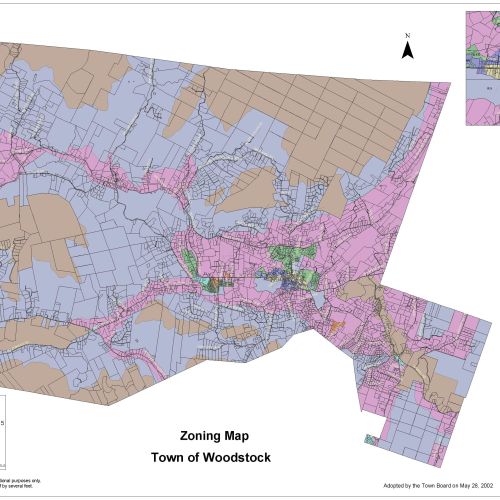
What uses are permitted on my property?
ZONING§ 260-14 Schedule of Use Regulations.
ecode360.com/109169?highlight=use%20regulations,used,uses,use#109169
TABLE for Schedule of Use Regulations [Amended 6-17-2014 by L.L.No.12014]
ecode360.com/attachment/WO2784/WO2784-260a%20Use%20Reg%20Table.pdf
What are my property set backs?
AREA AND BULK REGULATION TABLE
ecode360.com/attachment/WO2784/WO2784-260b%20Area%20and%20Bulk%20Reg%20Table.pdf
Article IV: AREA AND BULK REGULATIONS
ecode360.com/109175?highlight=setbacks,setback,zoning%23109232#109175
For lots of record which are smaller in area than the minimum lot area specified in the area and bulk regulation table, the following minimum setbacks shall apply: ZONING § 260-26 Modification of required yards.
ecode360.com/109232?highlight=setbacks,setback,zoning#109232
What does Woodstock Town code permit?
Follow this link, ecode360.com/WO2784, to be redirected to Town of Woodstock's Town Codes, and enter your search term in the bar at the top of the page.